Skip to main navigation Skip to main content
  • Member Login
Home
  • About Us
    • Introducing London Funders
    • Our People
    • Our mission and strategy
    • Governance & Annual Reports
    • Working at London Funders

    About Us

    London Funders is the only cross-sector network for funders and investors in London’s civil society.

    • Introducing London Funders
    • Our People
    • Our mission and strategy
    • Governance & Annual Reports
    • Working at London Funders
  • What we do
    • Connecting across London
      • Member-led Networks
      • Local Funder Forums
    • Enabling funder collaboration
      • Collaboration Circle
      • Grenfell Tower
      • London Community Response
      • Long-term funder collaboration: Propel
    • Championing the importance of ‘place’
      • London's Giving

    What we do

    With everything from regular events to facilitating learning and collaboration, this is how we enable funders from all sectors to be effective.

    • Connecting across London
    • Enabling funder collaboration
    • Championing the importance of ‘place’
  • Latest
    • News
    • Events
      • Past Events
    • Jobs
      • Past Jobs

    Latest

    Here's the latest news, views and job vacancies from London Funders and the wider funding community.

    • News
    • Events
    • Jobs
  • Learning
    • Our approach to learning
    • Join our learning community
    • Areas of Learning
      • What does it take to fund systems change?
      • Practising participation
      • Reconsidering Risk
      • Sharing power
      • Learning from our collaborations

    Learning

    Our ambition is to drive a learning culture across our networks, where shared data, intelligence and insight leads to better decision-making and action. 

    • Our approach to learning
    • Join our learning community
    • Areas of Learning
  • Join Us
    • Why join London Funders?
    • Meet our network
    • Latest audit: 2024/25
      • Latest audit: 2022/23

    Join us

    Find out more about who we are, how to join and who's in our network.

    • Why join London Funders?
    • Meet our network
    • Latest audit: 2024/25
  • Resources & Publications
    • Publications
    • Data insights for funders
    • Hubs
      • Covid-19 Resource Hub
      • Cost of Living Crisis Resource Hub
      • Refugee Resource Hub

    Resources & Publications

    Explore our resources for funders, including London Funders publications, datasets, tools & recruitment.

    • Publications
    • Data insights for funders
    • Hubs
Search the site

A new era for collaboration

Collaboration Learning

At a time of uncertainty and growing demand across civil society, this year’s London Funders Annual Conference brought together funders, communities and partners to reflect on what collaboration, leadership and long-term change now require. Across the discussions, one message became clear: lasting change in London depends less on programmes and more on relationships, trust and shared responsibility. 

The fourth and final blog in our post-conference series turns to the practical question beneath all the others. If complex challenges cannot be solved alone, what would it take to make genuine collective action possible across London’s civic, public and private systems? 

Ryan Boyce

Across this year's Annual Conference, a shared message continued to surface. The challenges shaping London’s future are not singular or isolated. Climate instability, widening inequality, democratic strain, and social fragmentation interact in ways that resist simple or traditional solutions. No single organisation or funding mechanism can resolve them independently.    

Our speakers note that our sector sometimes struggles to move beyond immediate delivery, short-term or narrowly defined outcomes. Our fourth and final panel challenged this model directly. Moving from short term, transactional activity to collective action requires a different foundation, one where power, risk and responsibility are genuinely shared rather than coordinated at the margins.  

This shift asks institutions to reconsider how decisions are made, how resources flow, and how success is defined across whole systems, rather than individual programmes.  

The discipline of sufficient alignment 

One of the most practical insights offered by the panel was deceptively simple. One hundred percent agreement is rarely achievable, and pursuing total agreement can stall progress entirely. Instead, collaboration depends on identifying where sufficient alignment already exists and acting there with confidence. 

The idea of a “70 percent rule” reframes potential disagreement. The panel explored how partners do not need to resolve every difference before moving forward. Instead they suggested the need for clarity about finding shared ground, alongside honesty about where they diverge. 

This honesty introduces a second requirement: vulnerability as a leadership skill. Developing a common agenda demands the confidence to admit uncertainty, partial knowledge, or institutional limitation. Rather than weakening collaboration, this openness allows trust to form and collective direction to emerge. In practice, vulnerability becomes less a personal trait and more a structural condition that must be facilitated, resourced and protected within collaborative spaces. 

Resourcing the invisible work 

If sufficient alignment provides direction, something else provides stability. The panel returned repeatedly to the often-unseen work that allows collaboration to function at all. 

Partnership working is frequently thought of as an extension of delivery rather than a distinct strand of work. Yet it’s acknowledged that effective collaboration requires its own capabilities, governance, legal frameworks, and shared planning. Without these, collective ambition remains fragile. 

This is the role sometimes described as the ‘system weaver’. Someone who understands the dynamics across multiple sectors to convene unlikely partners, maintain shared purpose and hold relationships steady through uncertainty. Crucially, this work cannot rely on goodwill alone. If collaboration is expected to deliver long-term change, the infrastructure that sustains it must be deliberately funded. Resourcing orchestration, facilitation, and hosting is not overhead. It was described as core, civic infrastructure. 

In practice, vulnerability becomes less a personal trait and more a structural condition that must be facilitated, resourced and protected within collaborative spaces.

From novelty to business as usual 

For collaboration to endure, it must move beyond exceptional projects into everyday practice. Government perspective offered one route toward this shift. 

The creation of the Office for the Impact Economy signals an intention to reposition cross-sector partnership from something novel or contentious into something routine. Capacity building inside government, policy levers such as procurement and commissioning, and alignment of public funding streams all point toward a future where collaboration becomes embedded rather than experimental. 

Corporate engagement offers another dimension. Panellists drew on a recent report published by Macquarie Group Foundation which explores opportunities for increased corporate social impact investment. It explores how private capital can support shared social goals alongside financial return, and argues that greater collaboration is one of the key elements of turning interest to action.

Many other practical examples already exist. We heard for example about common application and reporting frameworks developed by regional funder networks which show how reducing administrative burden can make collaboration materially easier for community organisations. Small structural shifts can unlock disproportionate collective benefit. 

Community leadership, time and trust 

Yet collaboration carries its own risks. One recurring concern was the tendency to shift responsibility onto communities without providing the time, capacity or resources required for meaningful participation. 

True community-led governance depends on more than invitation. It requires payment for time, investment in capability and facilitation that allows diverse voices to shape direction without being overwhelmed by process or scrutiny. 

For smaller organisations in particular, procurement systems and commissioning rules can unintentionally exclude the very partners collaboration seeks to include. Removing these barriers demands creativity, persistence and institutional willingness to redesign pathways into participation. 

For collaboration to endure, it must move beyond exceptional projects into everyday practice.

The mindset that makes collaboration possible 

As the discussion closed, attention turned from structure to mindset. Three reflections captured what this new era of collaboration may ultimately require. 

  • Funders and institutions must recognise that their role is to serve communities, not the reverse. Authority becomes meaningful only when grounded in public purpose. 
  • Place before programme. Lasting change depends on aligning around the needs and identity of place itself rather than the priorities of individual organisations or funding cycles. 
  • The importance of a host to 'hold' the shared space, keeping partners in relationship, maintaining direction and ensuring momentum does not dissolve when pressures rise. 

Across this four-part series, a consistent thread has emerged. From grassroots leadership to global learning, to devolution and visible change, each conversation has pointed toward a future for London shaped less by isolated interventions and more by the strength of relationships that connect people, institutions and places. A new era of collaboration is not simply desirable but necessary, and we're hugely excited about how we can play our part in this ambition.

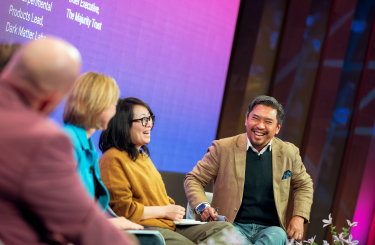
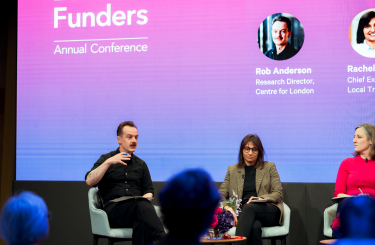
Our thanks to the panel Chair and panelists for their generosity, insight and experience, including: 

  • Fozia Irfan – Director of Impact and Influencing, BBC Children in Need (Panel Chair) 
  • Rachel Engel – Regional Director at Macquarie Group Foundation 
  • Fancy Sinantha – Founder and Director, The Dot & The Line
  • Emily Braid – Director at Office for the Impact Economy and Director of Public Sector Reform and Management in the Cabinet Office 
  • Jan Garrill – Associate Director of Yorkshire Funders 

Latest

  • News
  • Events
    • Past Events
  • Jobs
    • Past Jobs

Related

News

London as a global city

16 Feb 2026
News

Learning with and from London’s grassroots

16 Feb 2026
News

From Power to Pride: What Devolution Must Deliver for London

24 Feb 2026
Back to top
Home
  • About Us
  • What we do
  • Latest
  • Learning
  • Join Us
  • Resources & Publications

Contact us

020 4583 4700
[email protected]

Find Us

4 Chiswell Street
London, EC1Y 4UP

Follow

  • Follow us on Twitter
  • Subscribe on Youtube
  • Follow us on LinkedIn
  • ©London Funders 2025
  • Privacy and cookies
  • London Funders is a trading name of Funders Together. Funders Together is a company limited by guarantee registered in England and Wales (Company No. 5596299) and a registered charity (Charity No. 1116201).

Site by Effusion